Joining the Great Conversation by Sean Herhold
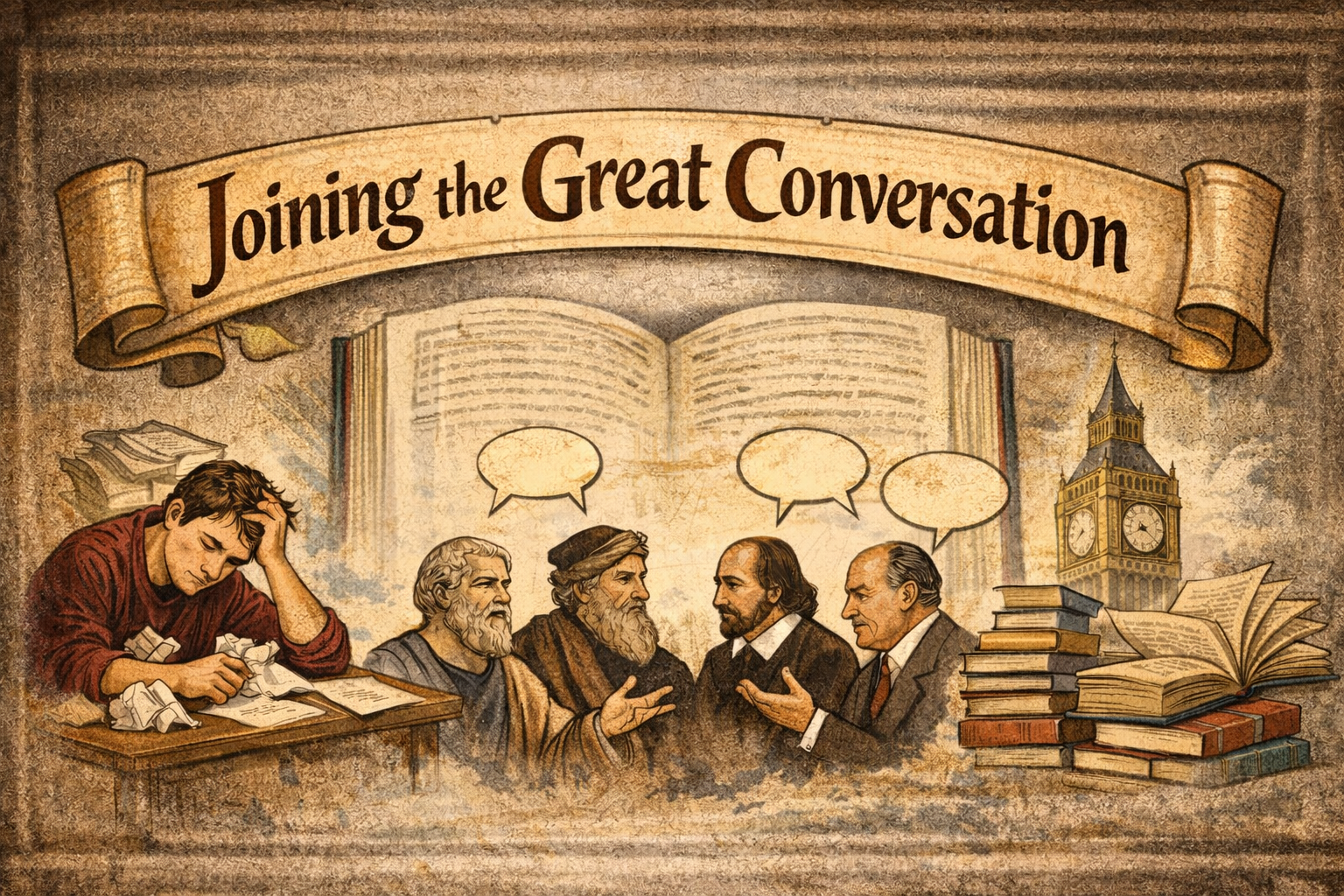
Every time I think I have an original idea, it is not long before I realize that I am way down the list of people who thought of it.
The first time I noticed this phenomenon was when I was working on my master’s thesis in grad school. I wrote about various philosophies and practices for family ministry in churches. Of course, I knew there were thousands of churches with just as many philosophies and practices for how to reach and minister to families, but I thought I had the bright idea of systemizing or categorizing all the different family ministry philosophies. As it turns out, I discovered this had already been done, and that a whole slew of books had already been written on this. My instructors explained to me that my discovery was great, but that my job was to bring all the prominent authors together into one conversation within my thesis, then to add to the conversation with my own original research.
I thought I was starting the conversation, but it turns out, I was just walking into a conversation that had been going on for decades. It was my job to ‘get caught up’ on the conversation so that I could effectively participate in the conversation. That experience was probably the most difficult singular experience I had at college, and yet it was also one of the most enjoyable and rewarding.
Now looking back, my thesis was quite amateur, and ultimately is not something I’m extremely proud of. But it was an important step in my education because even though the product was not phenomenal, the process was invaluable. Discovering and joining the conversation regarding family ministry was a precursor to what I would find next.
It was a little after I finished my thesis and got my masters that I discovered another conversation—the Great Conversation. Mortimer Adler, author of
Great Books of the Western World, explains the Great Conversation as the ongoing dialogue of great minds across centuries, expressed through the foundational works of Western civilization. Every classic work, whether by Plato, Augustine, Shakespeare, or Lewis, is essentially “talking” with earlier works and being “answered” by later ones. The greatest ideas and questions put forth by the greatest minds of history are preserved for us in what we call the
Great Books. Adler wrote, “Education is the process of being initiated into the Great Conversation.”
I was not personally introduced to the Great Conversation during my formal schooling, but I’m thankful that I discovered it. Much like when I was writing my thesis, I discovered the Great Conversation when I again thought I was having an original idea. This time, my idea was a philosophy of education centered around training in virtue rather than training for vocation. This time, I was not so surprised to find others had written on this very idea, but I was at least a little surprised that the conversation had been going on, not for several decades, but for several millenia.
I believed the type of student produced by education was more important than the knowledge being conveyed in education. I had known too many students who had had good grades, but didn’t know how to think on their own; students whose heads were filled with factual knowledge, but didn’t seem to know right from wrong. In other words, good grades did not translate to a life of wisdom and virtue. And the justification for this kind of education was that it was preparing students for the workforce. But, it was becoming more and more apparent that education wasn’t even doing that very well. I came to believe that a proper education was to train in wisdom and virtue, not for career advancement and job skills.
The next step was to find out what that kind of education would look like? Does it exist anywhere? And if so, how can we replicate it? I knew mainstream education did not contain the answer, that much was obvious. I read a book by John Taylor Gatto, an author who after teaching for about 30 years in the public school system, became one of the biggest critics of the system. Gatto pointed out that America had an era of genius that produced men like Franklin, Jefferson, Hamilton, Adams, Washington, Lincoln, Lee, and many others. But all of these geniuses lived before America had a public school system. Gatto pointed out that almost 100% of Americans in the late 1700s were literate. And not just barely literate, but effectively literate, reading and writing at levels that astounds the most literate professors of today. And not only were people of that era incredibly smart, they were also wise, courageous, prudent, and temperate, amongst a host of other virtues.
How did such an era of genius arise? It wasn’t due to mass schooling, that did not exist yet. It happened because as kids were taught to read, they were introduced to the Great Conversation as early as possible. Their minds were set upon life’s greatest questions as early as possible. Can you imagine living in a time when men often got their first job around age 12? When teenagers like George Washington would teach themselves trigonometry in order to get a job as a land surveyor at age 15? A time when teenagers in general were more interested in the deep conversations that adults were having rather than the silly games the kids were playing.
Today’s society seems keen on keeping kids kids for as long as possible. We do this by shielding them from freedom and responsibility, by distracting them with endless entertainment in movies, music, games, tv, and social media, and by patronizing them with shallow books, stories, and lessons. One of the biggest differences between the schooling of today, and the education of old is the introduction of students to the Great Conversation. And because students today are left out of the Great Conversation, they do not benefit from all the great ideas the best minds of history have had. Imagine trying to teach at an engineering school without ever talking about the discovery of the wheel. Sure the wheel is an old discovery, but it is still relevant to every engineer today. Every student should be given the privilege of entering the Great Conversation, of knowing what great thinkers have thought, and enabling them to stand on the shoulders of giants.
Right now, it is as if we are asking each generation to start over, to reinvent the wheel, to conduct trial and error experiments with ideas at the risk of their own life and happiness. By participating in the Great Conversation, people can start on third base regarding good and bad ideas. I’ll close with just one example: we don’t have to try socialism in every generation to know it is a bad idea that doesn’t work in real life. And yet nearly every generation is allured by various socialist concepts. However, a generation who has not participated in the Great Conversation will lack the knowledge of history, the understanding of human nature, and the wisdom needed to see the faults in socialism.
Now there is just one obstacle to overcome. The obstacle is this: the Great Conversation is contained in the Great Books, and people today don’t like to read. Some don’t like to read because they are simply not very good at it (short attention spans, lack of focus ability, etc.) others don’t like to read, simply because they’ve never read anything worthwhile that really grabbed their attention. I believe the Great Books are the solution to both of these problems. The Great Books cover a wide variety of topics and literary styles as well as reading levels and can appeal to any literate person. To get started, just simply type
Great Books of the Western World in your search bar, and choose the book that looks most interesting to you, or perhaps the shortest book, or the simplest book.
Each book you read will prepare you to begin the next one. You might have to ‘force yourself’ at first if you're not a reader, but soon you’ll begin noticing a snowball effect. Your ability to read will grow as will your desire. And just as the snowball gathers speed, your swiftness at picking up and consuming new books will increase as well. And the more books you have read, the more riches you’ll be able to dig out of the next one you pick up.
Sean Herhold, Principal
Faith Baptist Academy
Sean@faithbaptistofwc.org